How Houston HVAC Companies Can Get More Calls Before and During Summer
How a Houston HVAC company can get found for AC repair, installation and maintenance searches, with seasonal planning, reviews and call tracking.
Read the guide →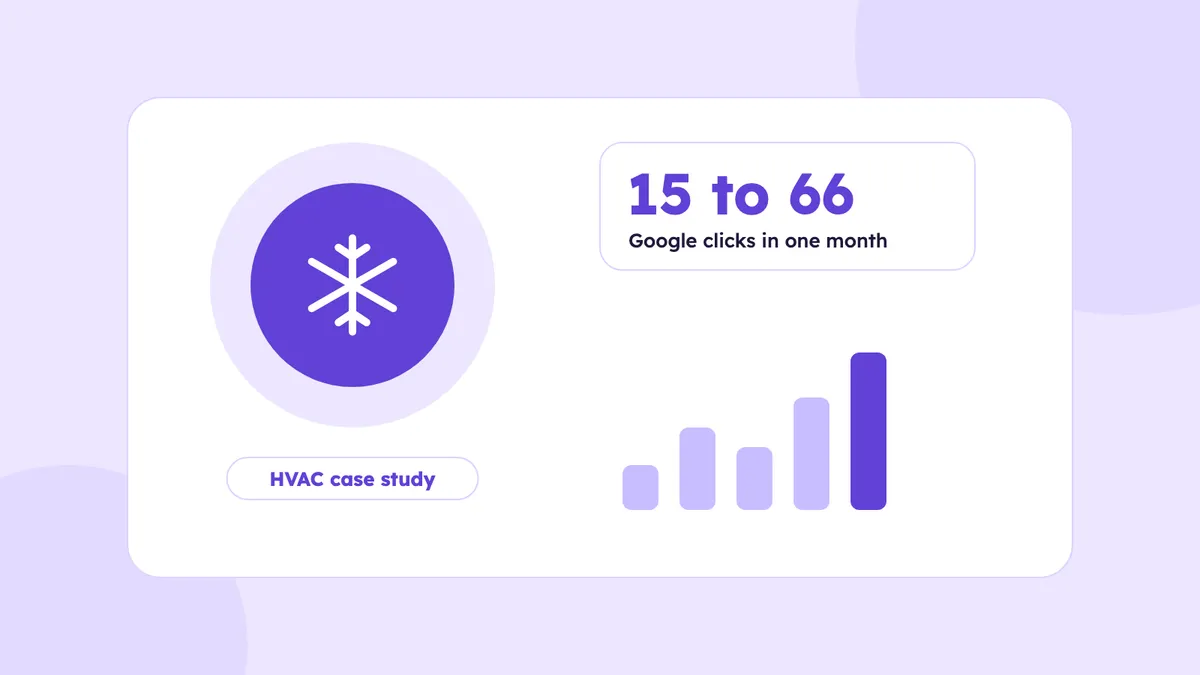
An HVAC company in Houston came to us with a simple complaint. The business was good, but almost nobody found it on Google. In August its website got just 15 clicks, and its Google Business Profile had zero interactions. A month later the same site had 66 clicks, and the profile had 108 interactions.
This case study explains what we found, what we changed and what the numbers do and do not prove. The client's name is kept private, and the data comes from Google Search Console and the Google Business Profile.
These were the numbers for August 2026:
An average position of 41.8 means a typical search showed the site on page four or five. Most people never scroll that far, which is why so few clicks came in.
We started with a full SEO audit. Three problems stood out, plus an empty Business Profile.
You can run a smaller version of this check yourself. Our technical SEO checklist shows how.
We worked on the website and the Business Profile at the same time.
| Measure | August | September | Change |
|---|---|---|---|
| Google Search clicks | 15 | 66 | +340% |
| Impressions | 3.94K | 8.22K | +109% |
| Click through rate | 0.4% | 0.8% | Doubled |
| Average position | 41.8 | 24.7 | 17.1 places higher |
| Business Profile interactions | 0 | 108 | From zero to 108 |
Clicks went up by more than four times, and impressions roughly doubled. The average position moved from page four or five to about page three. The Business Profile went from silent to 108 interactions.
It is worth being honest about the limits.
The site had 94 weak posts. Publishing more of the same would have made things worse. Removing duplicate and thin pages and improving the rest was more valuable than adding new posts. A smaller site with clear, useful pages is easier for Google to understand and easier for a customer to use.
With only 14 pages indexed, most of the site could not appear in search. Before you spend time on keywords or links, check that Google can find and index your important pages. In Google Search Console, the Pages report shows which pages are indexed and why others are not.
The website and the profile feed each other. A strong profile with a weak site sends visitors to a page that does not convince them. A strong site with an empty profile misses everyone who searches on the map. Both need attention if you want to be visible in local search. Our guide on how to show up in the map pack explains how the pieces connect.
When a site is redesigned, old addresses often stop working. Without redirects, visitors land on error pages and Google loses track of pages that already had some value. Setting up 64 redirects meant the old pages pointed to the right new ones. Google explains how permanent redirects work in its guide to redirects and Google Search.
If your website looks like this one did, start with four checks:
If you want an expert to check all four, see our full SEO audit, which covers strategy, on page, technical, backlinks and local review in one report.
We cannot say. Several changes happened in the same period, including the cleanup, the redirects and the profile work. The results show that the combined work moved things in the right direction.
Fixing indexing problems and removing weak pages can change how Google sees a site fairly quickly. Still, one month of data is early, and rankings can move up and down.
It can be, when posts are thin, duplicated or outdated and do not help anyone. Improve the ones that have a purpose, and redirect or remove the ones that do not.
It depends on how many old URLs exist. The rule is that every old page that had traffic, links or rankings should point to the closest new page.
We can review your site and tell you what we would fix first. We cannot promise the same numbers, because every business and market is different.
How a Houston HVAC company can get found for AC repair, installation and maintenance searches, with seasonal planning, reviews and call tracking.
Read the guide →
How I optimized a Nottingham roofing company's Google Business Profile and website, and what the tracking data showed after six months.
Read the guide →
How a cold call turned into five months of local SEO for an auto repair shop in Manchester, and what the Business Profile and website data showed.
Read the guide →We’ll check your website, your Google Business Profile and how AI tools describe your business. You’ll get a short video with what to fix first, within 3 business days.
Basic plan starts at $500/month · See pricing